Showing posts with label kawasaki ninja 250r. Show all posts
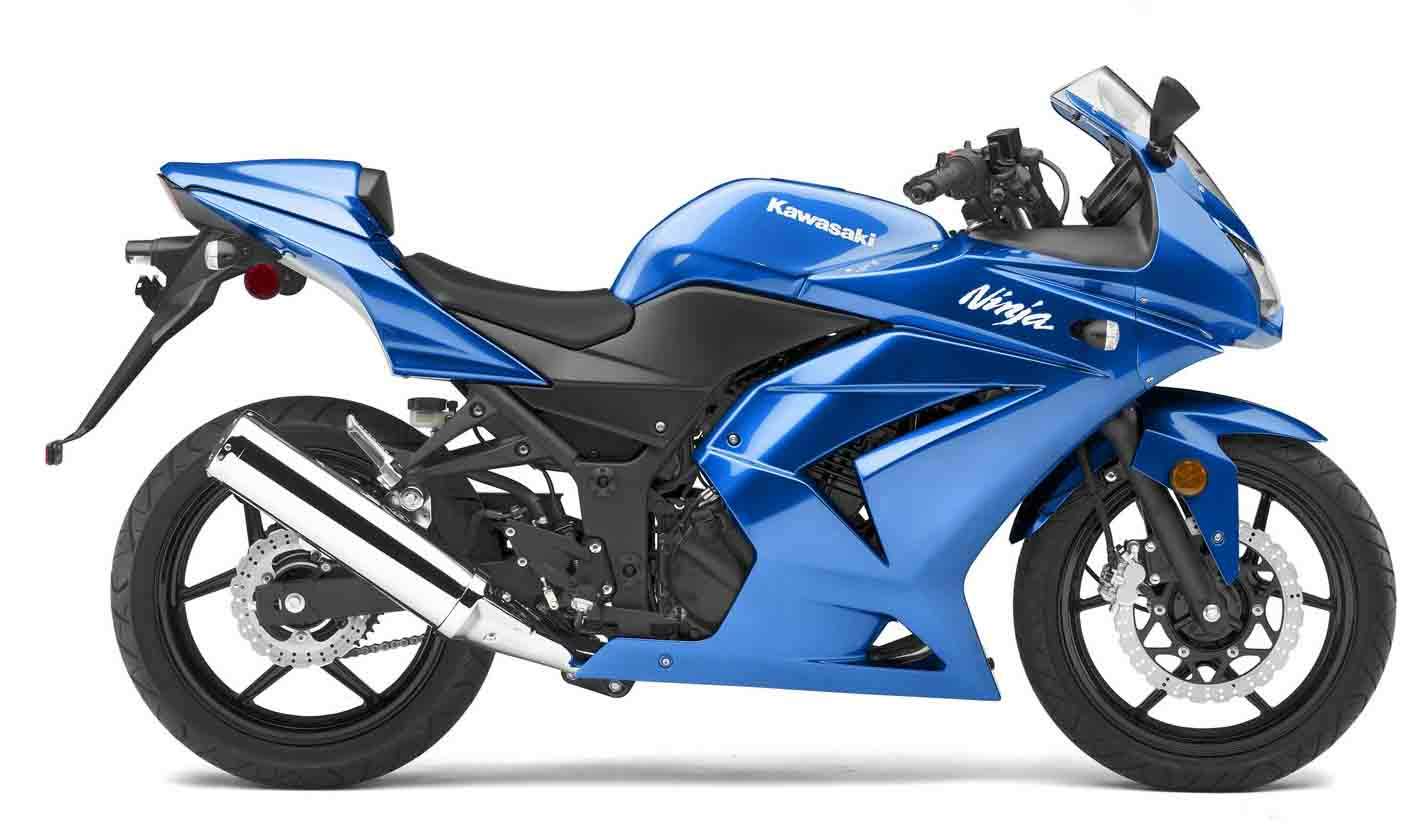
The Kawasaki Ninja 250R (previous generations had market-specific names) is a motorcycle originally introduced by Kawasaki in 1983. As the marque's entry-level sport bike, the motorcycle has undergone few changes throughout its quarter-century lifetime, having received only two substantial redesigns.
The fourth-generation model is marketed as the Ninja 250R in all markets. The motorcycle is also referred to by its platform designation, EX250, to which a generational suffix is attached. In the United States, previous generations of the bike (EX250-E/F/G/H) were already being marketed as members of the Ninja family of sport bikes, while outside of the U.S. the bike was known variously as the ZZR-250, ZX-250, or as the GPX-250R. One of the earliest generations, the EX250-C, was given the name GPZ-250.
The Ninja 250R's particular ergonomics, chassis design, and engine placement have resulted in a motorcycle that straddles the standard and sport classes. The Ninja's riding posture also falls somewhere between standard and sport. The bike is capable of running the quarter mile in 15.58 s @ 81.98 mph (131.93 km/h), although it had been 1 s faster in the prior generation, while providing the amenities of more utilitarian motorcycles, including bungee hooks for transporting cargo and space for a second passenger.The latest model, the EX250-J or fourth generation, brought the Ninja's first major update in many years. Appearance upgrades included 17-inch wheels and completely redesigned fairings which give the motorcycle a sleeker, more modern appearance.
The first generation was produced between 1983 and 1984, and known by the production number EX250-C. It was sold as the GPZ-250. Sold only in its home market of Japan, this earliest, belt-driven version was first produced in 1983, and shares no commonality with later generations.[citation needed] The bike has 35mm fork tubes
The fourth-generation model is marketed as the Ninja 250R in all markets. The motorcycle is also referred to by its platform designation, EX250, to which a generational suffix is attached. In the United States, previous generations of the bike (EX250-E/F/G/H) were already being marketed as members of the Ninja family of sport bikes, while outside of the U.S. the bike was known variously as the ZZR-250, ZX-250, or as the GPX-250R. One of the earliest generations, the EX250-C, was given the name GPZ-250.
The Ninja 250R's particular ergonomics, chassis design, and engine placement have resulted in a motorcycle that straddles the standard and sport classes. The Ninja's riding posture also falls somewhere between standard and sport. The bike is capable of running the quarter mile in 15.58 s @ 81.98 mph (131.93 km/h), although it had been 1 s faster in the prior generation, while providing the amenities of more utilitarian motorcycles, including bungee hooks for transporting cargo and space for a second passenger.The latest model, the EX250-J or fourth generation, brought the Ninja's first major update in many years. Appearance upgrades included 17-inch wheels and completely redesigned fairings which give the motorcycle a sleeker, more modern appearance.
The first generation was produced between 1983 and 1984, and known by the production number EX250-C. It was sold as the GPZ-250. Sold only in its home market of Japan, this earliest, belt-driven version was first produced in 1983, and shares no commonality with later generations.[citation needed] The bike has 35mm fork tubes
Kawasaki Ninja 400 cc Coming Soon. Japanese motor manufacturers, Kawasaki did not want to work, to show themselves as specialists in the world of motor sport. after successful re kawasaki ninja 250 R motor sport intend to launch their latest model that is Ninja 400. so with the presence of this latest model also seemed to fulfill the models that existed before the Ninja Ninja 250R, 500R, 650R, ZX-6R, ZX-10R and ZX-14.
kawasaki ninja 250r